

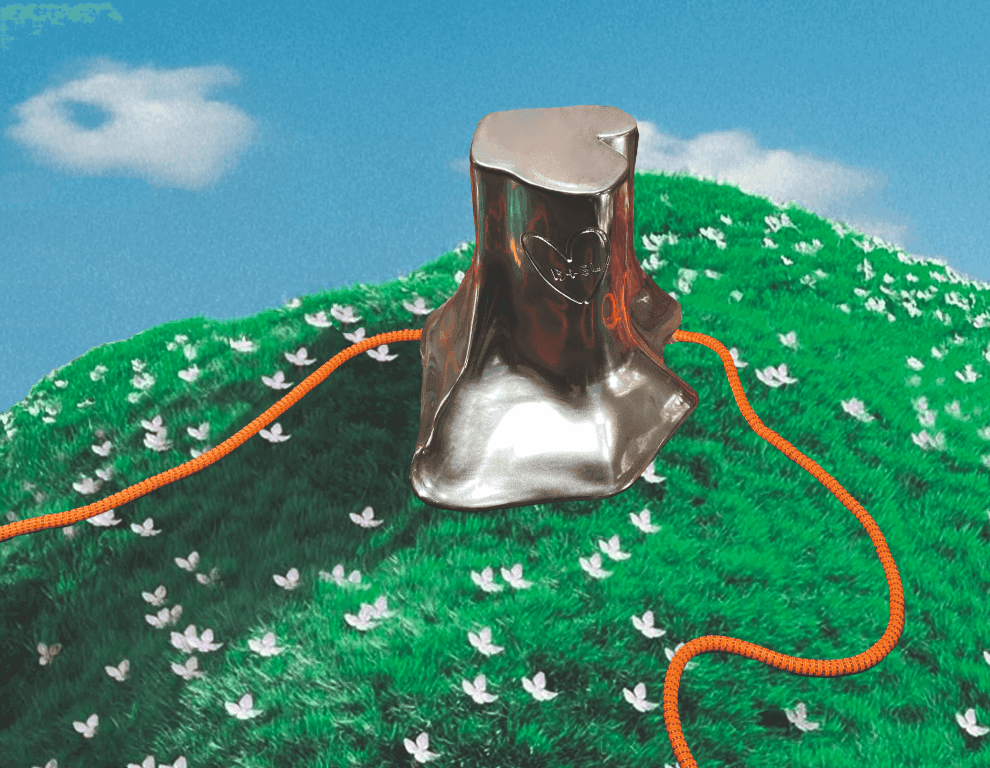

Dynamic #3
Imagining differently
Regarding relationship with nature and environment, collective momentum hits a plateau. While awareness of issues remains strong, the passage to action loses steam as individuals struggle to translate their deep convictions and commitment into lasting actions. Feelings take over engagement: fatigue, discouragement, or sense of powerlessness reflect an ecology experienced as constraint rather than a mobilizing horizon. This feeling risks giving way to a form of resigned indifference. Facing this collective weariness, a new ambition emerges: regenerate.
French people's willingness to adapt their lifestyle for climate decreases (-13 points since 2018 according to Obs'COP in 2024), while in the professional world, this tension sometimes manifests as ecological brown-out, characterized by psychological difficulty associated with loss of meaning in work or feeling of uselessness facing systemic issues according to François Baumann (Le brown-out: Quand le travail n'a plus aucun sens, Éditions Josette Lyon, 2016).
It's no longer enough to denounce: it's necessary to offer sensitive and collective experiences that restore desire to act. Counter to classic sustainability approaches, some advocate for a narrative break: no longer just limiting damage, but imagining companies and brands capable of repairing, connecting, revitalizing.
New philosophies accompany this movement: 'optimistic nihilism,' which invites tracing a personal path freed from social norms, or 'rational optimism,' which bets on our capacity to build concrete solutions, without yielding to despair.
These narratives inspire a new contract between company, human, and planet. Author AnnaMarie Swan (Ecological organisations: A Design Lens, online and open-source, 2024) proposes an ecological organization model: structures that no longer just seek to reduce their footprint, but experience themselves as actors of collective well-being and ecological balance.
Far from being a constrained duty, ecology thus becomes a space of desire, meaning, and cohesion. It reconnects individuals to a collective adventure, in which small gestures take root in a vaster and fairer vision.
In this context, it's no longer about celebrating performance, but offering transformative experiences, capable of reviving engagement and embodying lucid but mobilizing hope. Re-enchanting ecology means offering individuals a new reason to believe in it, by projecting them into a future carrying meaning, connection, and hope.
Regenerating engagement
While climate issues occupy a central place in societal expectations, companies and brands find themselves facing a complex equation: how to maintain authentic ecological engagement without increasing individuals' mental load? The answer might well lie in a new posture: regenerate engagement rather than stimulate it by injunction. This is the approach of Komeet (formerly Wenabi and Vendredi), a social startup that facilitates companies' solidarity engagement by connecting them, via a dedicated platform, with associations carrying concrete projects.
What if slowing down became a new way to live experience, deeper, more sensory, more human?
→ An intergenerational ecological consciousness
Contrary to preconceptions, environmental sensitivity crosses all generations: 72% of Gen Z and 68% of baby boomers worldwide declare being concerned about the environmental future (Bain, 2023). Ecology thus becomes a unifying lever, capable of bringing individuals together beyond preconceived segmentations – we find the need to create collective around shared desirable horizons. And for good reason, eco-anxiety brings forth new vocations around sustainability and attraction to 'green' skills: recruitments for environment-related professions have consistently surpassed the overall hiring rate worldwide, four years running (LinkedIn x Future Jobs 2023, World Economic Forum).
→ Companies as emotional regulation actors
Facing eco-anxiety, companies have a key role to play. They must assert themselves not only as action engines, but also as relief spaces. By cultivating transparency and empathy, they'll weave a sincere and lasting connection with individuals, accompany without guilt, comfort without fleeing complexity. The organization becomes prescriber less than accompanier. Ecology, it transforms to become a shared experience and a powerful cultural lever to align individuals around a collective narrative, carrying meaning and future.
→ Moving from individual activation to collective intelligence
Over-solicited in their role as ecological 'consummer-actor,' individuals now aspire to be relieved, while remaining involved. This requires rethinking experiential formats by offering immersive, sensory, and engaging experiences that actively participate in a transformation process: foster learning communities, support engagement collectives, organize transverse reflection times. The company or brand then becomes an incubator of collective intelligence around environmental challenges.
68% of baby boomers declare being concerned about the environmental future.
Knepp
Knepp, a former struggling agricultural estate in the UK, has become an emblematic example of rewilding by welcoming threatened species and rustic domestic animals to regenerate ecosystems. Inspired by ecologist Frans Vera, the project relies on animal disturbance to enrich biodiversity. Its founders now experiment with regenerative agriculture, seeking to reconcile production and nature. Knepp offers experiences at the heart of nature to reconnect with it.
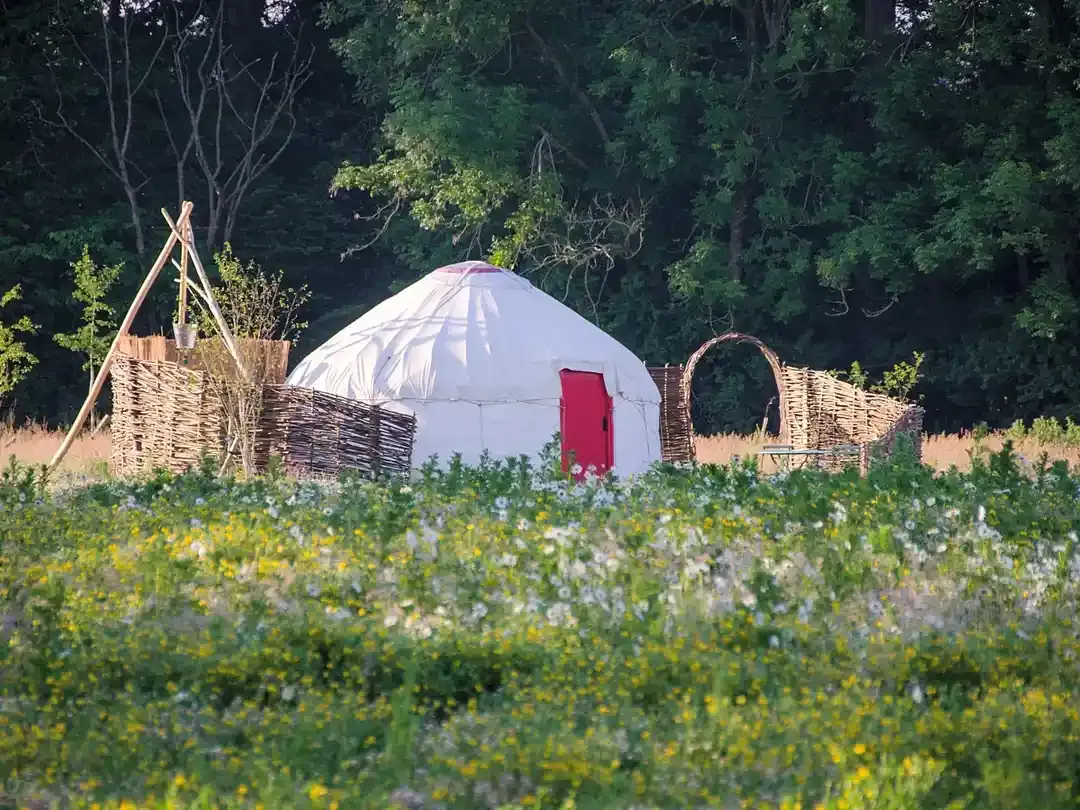
Knepp
Get Lost
Get Lost is a London-based creative consultancy, founded by Julian Ellerby, offering nature-based experiences for corporate clients. The objective: learn, understand, and be inspired by ecology principles – like circularity or resource efficiency – through sensitive and educational immersions in the living world.
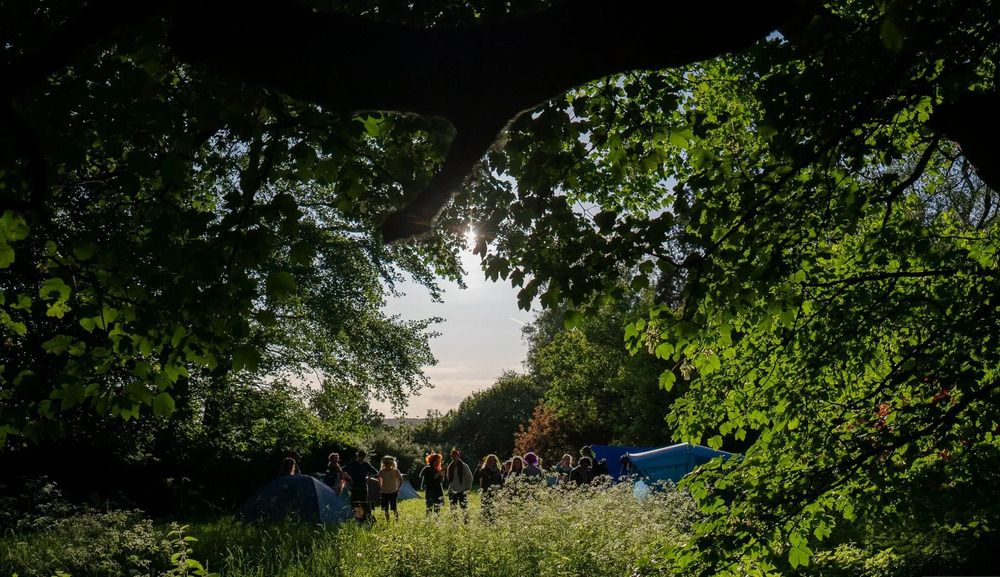
Get Lost
Material Works Architectures
Designed by Material Works Architecture, Sustainable Workspaces in London transforms a former historic building into a work ecosystem for climate startups. Here, ecological engagement is in both substance and form: recycled materials, reuse of existing structures, demountable design, and low carbon footprint. Work becomes a terrain of co-creation, solution research, and emotional support facing environmental challenges.
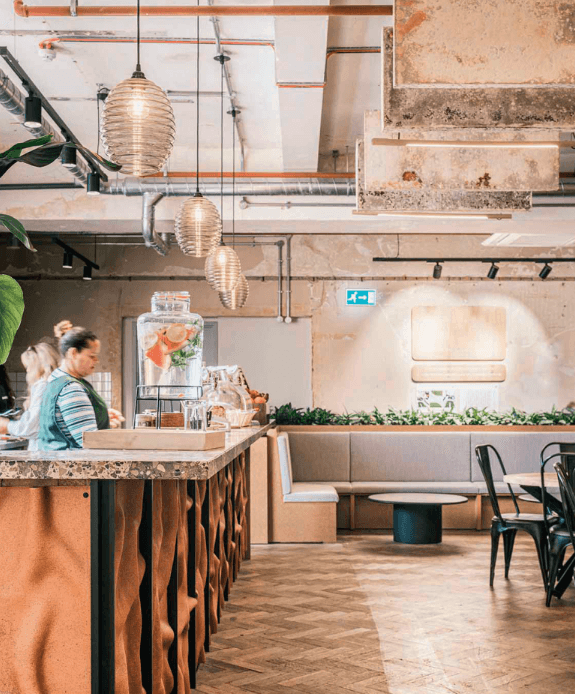
Material Works Architectures
Activating imagination
When everything wavers, imagining other possibilities becomes an act of resistance. Thinking broader, leaving worn models, inventing new ways to work, produce, live together… Imagination is no longer an escape: it takes the form of transformative energy, a force that draws new perspectives where we only see dead ends. In companies as elsewhere, imagination is no longer a luxury, it's a compass.
What if imagination became the starting point of transformative experiences, capable of collectively reinventing our relationship to the world?
→ From creativity to strategic imagination
An awareness operates: it's no longer enough to adapt to a changing world, we must imagine differently. If 96% of professionals believe creative ideas are key to their organization's long-term success (Canva x Harvard Business Review, 2023), imagination thus becomes a strategic muscle: it feeds brand visions, inspires teams, reinvents economic models. It no longer limits itself to artistic field or product innovation world: it irrigates company culture, citizen engagement forms, and collective narratives.
→ Reconnect through narrative
Saturated with alerts, news or fake news, individuals, marked by informational fatigue, let new expectations emerge: those of meaning-carrying narratives that allow projection. Far from greenwashing or utopias, it's about offering visions both sensitive and structured, that reconnect to human and living.
→ Re-enchanting work also means imagining tomorrow
The organization can become a place where we imagine together new ways to produce the world, act, work, build the future. By developing this collective capacity to imagine, the company becomes more innovative and more attractive. As journalist and essayist Naomi Klein says: 'Imagination is perhaps our only resource powerful enough to move forward – provided it's accompanied by courage and action.'
96% of professionals believe creative ideas are key to success…
Desirable Futures
The Institute for Desirable Futures offers a Deep Time Walk, a guided walk of 4.6 km symbolizing the 4.6 billion years of Earth's history. This immersive experience invites rethinking our relationship to time and the planet, and encourages positive action for the future.

Desirable Futures
Tellart
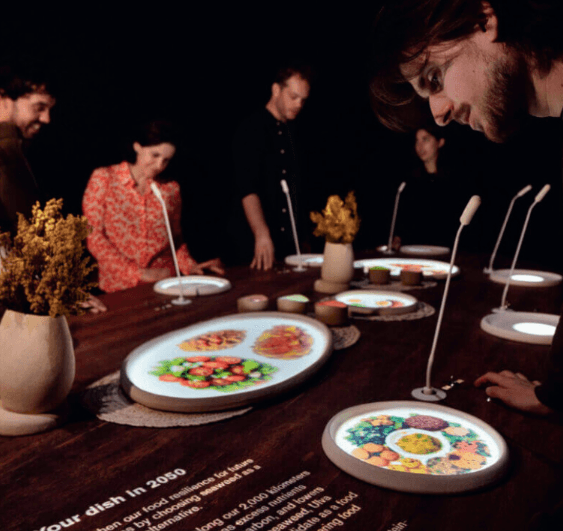
Created by Tellart for the UAE House of Sustainability at COP28 in Dubai, Dinner in 2050 offered a speculative culinary experience. Guests shared with artificial intelligence their favorite dishes, which were then analyzed and replaced by low-carbon footprint alternatives: grasshoppers and millet instead of lamb, algae instead of broccoli, or lab-cultured meat instead of beef.
Tellart
Spaceship Earth
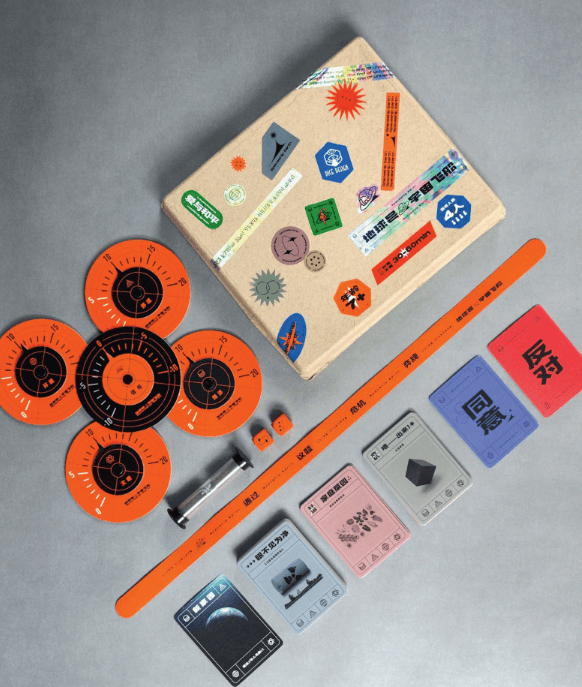
Co-created by game company DICE and Greenpeace East Asia office, the prospective board game Spaceship Earth entrusts each player with responsibility for a distinct part of global society. Together, they must negotiate a collective, systemic, multi-stakeholder path toward ecological regeneration.
Spaceship Earth
Event scenarios
Key Trend #5 / Regenerating engagement
In a context of misalignment, the event becomes a terrain for reconnecting to action, values, and individual impact. It reactivates the power to act through accessible, concrete, and transformative formats.
1. Encourage daily micro-engagements
The collective also builds in small gestures. The event offers a simple expression space, where each employee shares an eco-responsible or solidarity initiative, personal or professional. A physical or digital wall compiles these actions and makes visible a dynamic of discreet but constant engagement. By valuing these gestures, we install a culture of light, shared, and lasting action.
2. Rethink work in light of new balances
What if engagement went through renunciation? The event opens a shared reflection space on practices to evolve: slow rhythms, lighten processes, humanize management… Through co-construction workshops, teams imagine more sober, resilient organization models aligned with contemporary aspirations.
3. Give everyone a place in transition
Moving from declarative to collective action. The event becomes a participatory laboratory where each team can concretely contribute to the company's CSR commitments: energy, inclusion, responsible digital, sobriety… This format anchors transition in daily life and generates a sense of lasting appropriation.
Key Trend #6 / Activating imagination
To face uncertainty, the event no longer just informs: it opens spaces for projection, inspiration, and collective creativity. Imagining together becomes a strategic lever for transformation.
1. Open reflection through sensitive inspiration
The event becomes a reflective pause moment, through screenings of inspiring films, documentaries, or fictions about coming transitions. Whether on-site or remotely, these regular gatherings nourish collective intelligence around grand narratives: ecology, social innovation, desirable futures… We watch, discuss, imagine.
2. Prototype the company's possible futures
What could our organization look like tomorrow? In a 'futures studio,' physical or virtual, teams try design fiction, collective narrative, idea prototyping. This immersive format stimulates boldness, breaks mental routines, and allows everyone to actively participate in building a more coherent and desirable future.
3. Create concrete bridges between values and personal engagement
Some employees aspire to engage differently. The event gives them this opportunity by offering solidarity or environmental missions, to conduct over 1 to 2 months, parallel to remote work. A concrete way to connect company project and quest for meaning, while valuing engagement outside the walls.
Want to live the experience?

Want to live the experience?